
Reviewed · RIGA OLD TOWN TOURS
2 Hours Walking Tour in Legends and Secret of Riga’s Old Town
Riga’s Old Town is far more than pretty facades and church towers. This private walk with Lina threads through narrow lanes, medieval guild territory, underground remnants, execution legends, alchemical symbols, and the story behind Riga’s famous Black Balsam. It is the sort of tour that helps you see why a plain-looking doorway or small plaque matters.
I like the small private format, since your group can ask questions and pause for explanations. I also like the mix of major sights and easy-to-miss details, including Rozena iela, the Swedish Gate, the Baltic Way footprint, and the basement area connected with an old Riga building. The Black Balsam tasting adds a local flavor rather than another quick photo stop.
The main consideration is pace. The advertised duration is about two and a half hours, yet the itinerary includes nearly 30 stops. Church visits are limited to free sections or exterior views, and admission fees or taxes beyond the included tasting are not covered. Wear good walking shoes and confirm the exact meeting point before you set out.
Key points at a glance
- Nearly 30 stops in about two and a half hours: You cover Riga’s main Old Town sights along with small lanes, plaques, guilds, and legends.
- Lina’s story-led guiding: She uses historical photographs and visual material to explain how fires, war, and rebuilding changed the city.
- A private tour for up to six people: The price is $108.43 per group, making the cost reasonable if you have several people together.
- Black Balsam tasting included: You sample Riga’s famous herbal drink at a souvenir shop or the Black Magic Bar.
- Mostly exterior sightseeing: Several churches and buildings are viewed from outside, or through their free-access areas.
- A useful first-day orientation: You finish knowing where the key squares, monuments, museums, restaurants, and meeting points are.
Why this walk works well as your first Riga outing
I would put this tour early in a Riga visit. It gives you a map in your head before you begin exploring alone, and it connects scattered sights into a story.
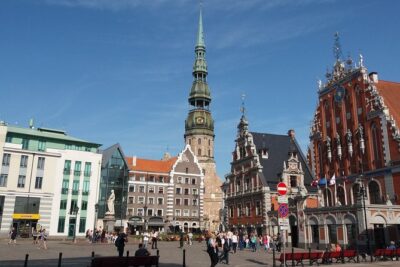
The route begins around St. Peter’s Church and moves through Town Hall Square, the Dome area, the medieval lanes, the old fortifications, and the central monuments near the Freedom Monument. You are not simply checking off buildings. You are learning why Riga’s merchants, craftsmen, soldiers, clergy, and city officials shaped the streets in very different ways.
Lina’s approach also appears to suit people who like context. She brings a folder or book of historical pictures, including images showing buildings before and after fires and wartime destruction. That visual comparison can make Riga’s restored facades easier to understand. A polished building is not always an untouched medieval survivor. Often, it is a reconstruction with several chapters behind it.
The tour is offered in English and is private, so your group gets the guide’s attention. That matters on a walk packed with small facts. You can ask about a symbol, stop for a photo, or request a restaurant or museum suggestion without holding up a large group.
More ways to see the Old Town:
- Riga Old Town walking tour
★ 4.5 · 304 reviews - Riga Old Town Walking Tour in a Small Group
★ 4.5 · 132 reviews - Private Riga Old Town Walking Tour
★ 5.0 · 62 reviews
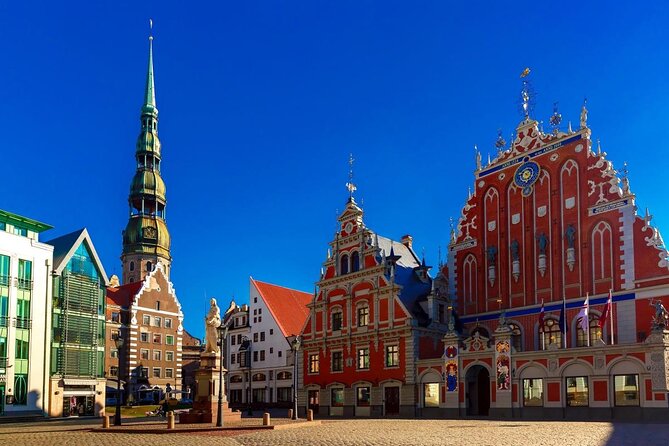
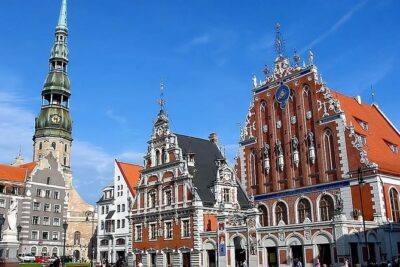
St. Peter’s Church and the stories above Town Hall Square
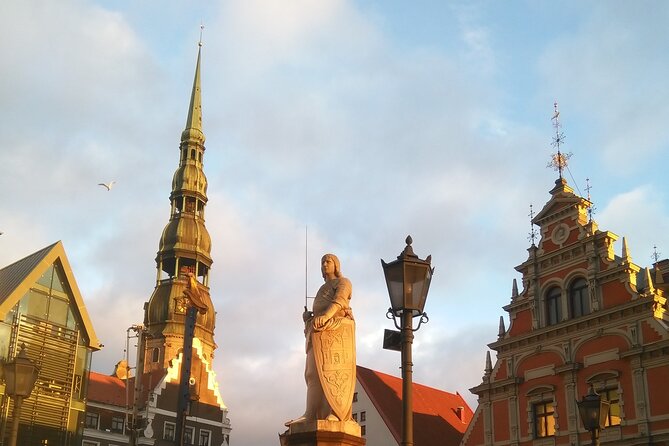
At St. Peter’s Church, you look at Riga’s oldest Lutheran church from outside and enter the free part. Lina explains the golden rooster tradition, the Christian meaning of the rooster, and the strange role of the number 666 in the church’s fate.
That is a good example of the tour’s style. Instead of giving you only the construction date, Lina ties the building to beliefs, symbols, and local stories. The church’s rooster is not just a decoration on a skyline. It connects to weather direction, Christian symbolism, and the way people once read meaning into buildings.
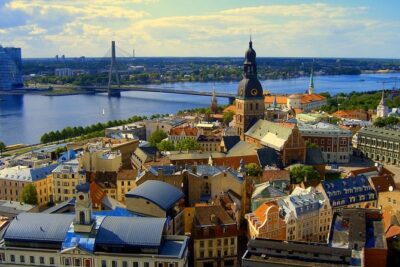
Town Hall Square is the next major stop. It began as a market and later became the city’s administrative and ceremonial center. From here, you can look toward the Daugava River, the Latvian National Library, and the Museum of the Occupation of Latvia.
This is also where several stories meet. You hear about the Key to Riga, the origins of the decorated Christmas tree tradition, and the small memorial marking the first decorated tree in 1510. The Christmas tree claim is one of Riga’s most popular historical talking points, and the plaque gives you a precise place to see it.
Black Heads, Roland, and medieval city power
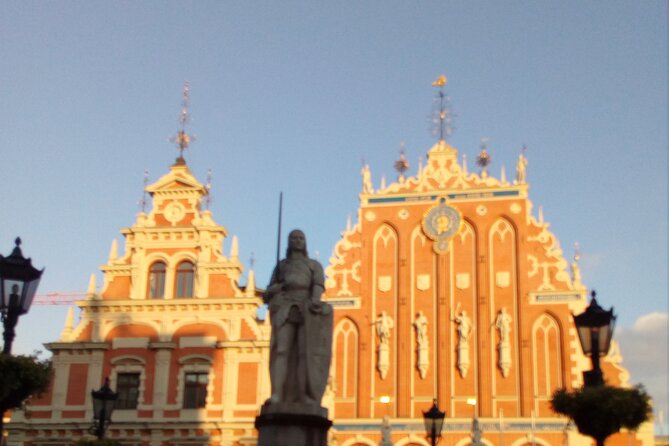
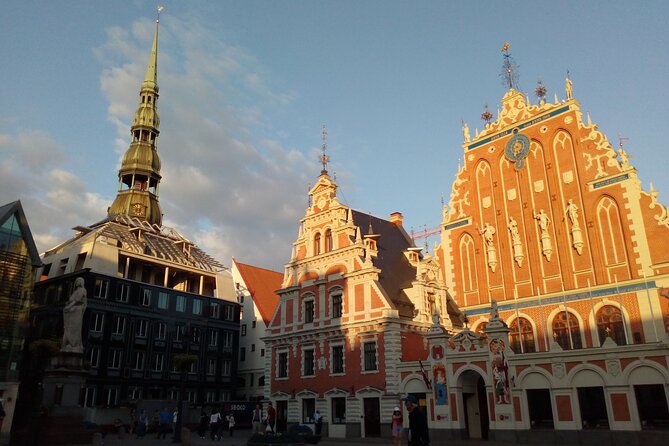
The House of the Black Heads is one of Riga’s most ornate buildings. Lina explains the facade, the clock, and the Brotherhood of the Black Heads, a group connected with unmarried merchants and city life.
The tour also looks at the building’s free-access area and its underground section. You hear about the alchemical and hermetic symbols worked into the facade. These details reward a closer look, especially if you later return with time to study the sculptures and coats of arms.
In the middle of Town Hall Square is Roland’s statue. Roland represents medieval urban freedom and Riga’s place in the Hanseatic world. Riga joined the Hanseatic League in 1283, and the statue’s shield and sword carry their own stories.
You then pass through the inner street of Riga City Hall on Jaunavu Street. A waterfall called River of Time commemorates Riga’s 800th anniversary in 2001. The route also points out a contemporary work associated with Pharaoh Tutankhamen, an unexpected detail among the medieval buildings.
Narrow lanes, old cellars, and the Bremen musicians
Rozena iela is one of Riga’s narrowest streets. You see the exterior of a 13th-century city hall wine cellar and learn why some of these cramped lanes were linked with the idea of the drunk knight. The lane is quick to cross, but its tight scale helps you picture an older city built for foot traffic rather than cars.
At the Bremen Town Musicians monument, you get one of Riga’s most recognizable photo stops. Bremen gave the sculpture to Riga in 1990, reflecting the sister-city relationship between the two places. The connection also reaches back to Bishop Albert, the Bremen-born founder associated with Riga.
The monument has a local wish-making tradition. You can rub or touch the animals, though the most important part of the stop is the connection between Riga and Bremen. It is a light moment after the darker stories about medieval punishment and religious life.
More walking tours in Riga:
- Best of Riga Walking Tour – Highlights and Hidden Gems
★ 5.0 · 147 reviews - Old Town Walking Tour of Riga
★ 4.5 · 28 reviews - Riga Art Nouveau walking tour
★ 4.0 · 27 reviews - Riga walking guided Sightseeing tour
★ 5.0 · 19 reviews
Dome Square, the cathedral, and the old merchant clock
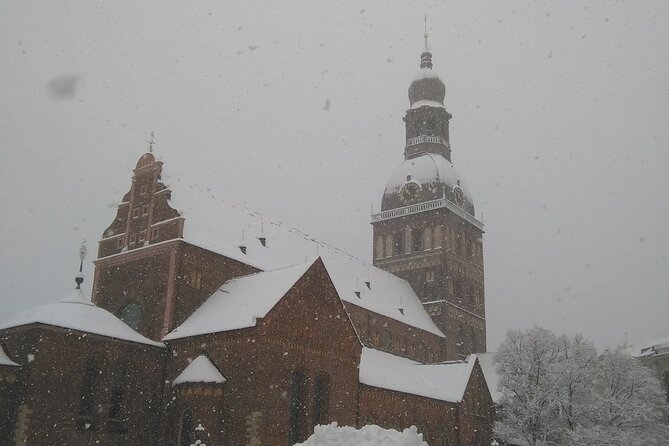
Dome Square is Riga’s largest Old Town square and the setting for the main Christmas market. You look toward Riga Cathedral, count the golden roosters visible from the area, and hear about the square’s geometry and design.
At Riga Cathedral, the visit is limited to the free section rather than a full paid admission. Lina discusses the foundation and construction of the church, its pipe organ, and a work attributed in the tour description to Raphael Santi. The organ was once the largest in the world in the 19th century and remains known for its sound.
One charming detail concerns Riga’s merchants. They used the cathedral’s rooster as a way to plan the day. It gave the city a practical time marker long before the modern clockwork of a busy capital.
The nearby Riga Stock Exchange Building brings a sharp change in style. Its Venetian Neo-Renaissance design includes a Venetian gondola, described as the only one in Riga. The building now houses a foreign art museum, but the tour focuses on the architecture and the unusual gondola display.
The Three Brothers and the city’s older domestic life
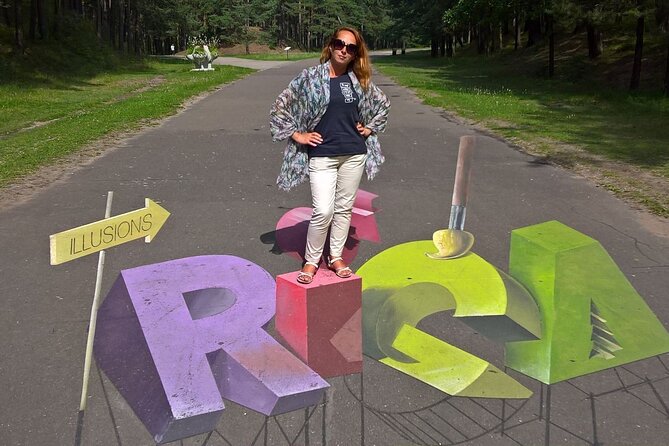
The Three Brothers are among the best stops for understanding how ordinary homes developed in Riga. The three adjoining houses represent different periods of dwelling construction, with the oldest dating to the 15th century.
You visit the oldest house’s free area and the Latvian Museum of Architecture. In the inner yard, Lina points out an old coat of arms connected with Riga. She also explains the medieval window tax, a useful reminder that architecture was shaped by money and government rules as much as by taste.
St. Jacob’s Catholic Cathedral is viewed from outside. Its bell has a grim purpose: the bell of the poor sinners rang when a condemned criminal was taken from prison to Town Hall Square for execution.
These stops work well together. The Three Brothers show domestic life, while St. Jacob’s Cathedral recalls the city’s religious and judicial power. Riga’s streets begin to feel less like a set of monuments and more like a working medieval town.
Powder Tower, Swedish Gate, and the soldier barracks
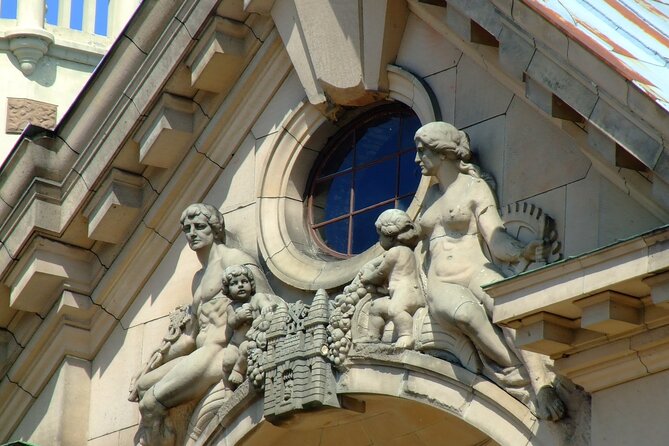
The Powder Tower is Riga’s largest surviving tower from the 14th century. You view it from outside and can later visit the Latvian War Museum, which occupies the tower. Admission to the tower and museum is free, according to the tour details.
The Swedish Gate is the only surviving outer gate of Riga’s Old Town. It dates from the Swedish period, which explains the name. Lina also points out the house associated with the city executioner and tells the legend of the Riga ghost.
Nearby, Jacob’s Inn, also called St. Jacob’s Barracks, is described as the longest building in the Old Town. It once housed 5,000 Swedish soldiers. Today, its long facade contains souvenir shops, cafes, restaurants, and offices instead of military quarters.
This section gives you a quick lesson in Riga’s defensive past. The walls, gates, towers, and barracks are not spread across a museum display. They are part of the streets you are walking through.
Black Magic Bar and the taste of Riga
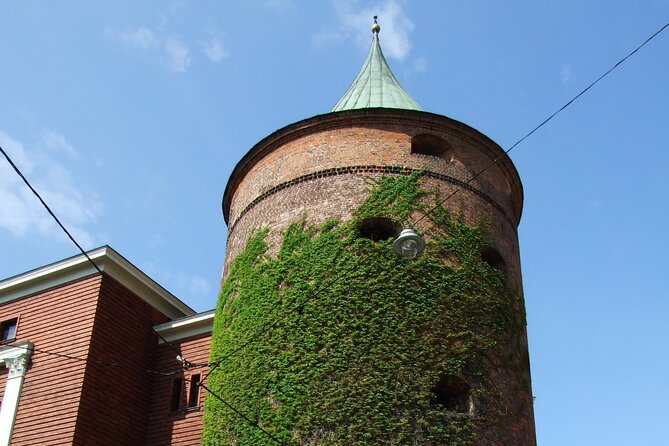
The Black Magic Bar is one of the tour’s most distinctive stops. According to the local legend, the site was once a pharmacy where Riga Black Balsam was invented in the 18th century.
You can sample Riga Black Balsam, the dark herbal drink associated with Latvia. The cafe also serves coffee, tea, sweets, cakes, different balsam varieties, and mixed drinks based on the famous liquor. Lina explains the alchemical symbolism connected with the place and points out the secret door leading to the supposed laboratory of Abraham Kunze, the drink’s inventor.
The tasting is included, but it is not a full meal or a long food stop. Think of it as a short introduction to a Latvian specialty. If you dislike strong herbal spirits, ask about the available options rather than assuming you will want a full serving.
Freedom Monument and Riga’s modern identity
The walk then reaches the Freedom Monument, built during Latvia’s first independent republic. Lina explains its hidden symbols and why it matters so much to Latvian identity.
This is an important change of subject. Much of the route deals with medieval Riga, German merchants, religious buildings, and Swedish rule. The Freedom Monument shifts the focus toward Latvian independence and national memory.
The nearby Laima Clock is a familiar meeting point. Laima is Latvia’s best-known chocolate producer, and the clock took its name from the company. This is a simple stop, but it helps you recognize a location you may use later when navigating central Riga.
You also pass Ķēniņu iela, described as Riga’s shortest street, and hear how it became so short. These tiny stops may not deserve a separate visit, but they fit naturally into a walking route and give you details to notice when you return on your own.
Cats, guilds, and the Baltic Way
The Cat House is another classic Riga sight. Its black cats connect to a local legend about the building and became one of the city’s familiar symbols. Lina explains the story rather than leaving you with only a photograph of the rooftop figures.
At Livu Square, you hear about the square’s history and hidden symbolism, including the monument of a Liv head. The Small Guild recalls Riga’s craftsmen, while the Great Guild points to the city’s merchants. The Great Guild operated from 1354 to 1936, and Riga’s membership in the Hanseatic League helped German merchant organizations gain power in city life.
The Baltic Way Footprint Monument brings the route into the 20th century. A small red granite footprint marks the 1989 human chain in which about two million Estonians, Latvians, and Lithuanians joined hands across roughly 600 kilometers from Tallinn to Vilnius through Riga. The demonstration protested the 50th anniversary of the Molotov-Ribbentrop Pact while the Baltic states were under Soviet rule.
It is easy to walk past this small marker. With the story, it becomes a powerful reminder of how a modest place can carry national memory.
Theatre, St. John’s Church, and the old fortification line
The route also points out one of the oldest Russian theatres outside Russia. Built during the Russian Empire in the second half of the 19th century, it is a Florentine Neo-Renaissance building.
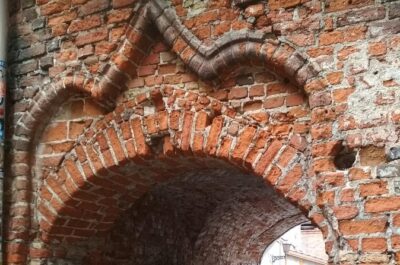
At St. John’s Church, you hear the unsettling story of two Dominican monks supposedly walled alive into the church. Lina shows where they were found during 19th-century reconstruction and points out the oldest Riga gate leading to the Dominican monastery.
You then see a section of the 13th-century fortification wall built by Germans during the period of the Livonian Order. Kalēju iela, the Old Town’s longest street, once followed the embankment of the Riga River. Blacksmiths worked along it, and the street still gives a clue to the waterway that once shaped the city.
The Riga Radio and TV Tower appears in the wider view. At 368.5 meters, it is described as the tallest tower in the European Union. It was built between 1979 and 1989 with funding from the central Soviet government.
The final Christmas tree marker returns you to Riga’s claim as the town of four capitals and to the 1510 decorated-tree tradition. The route closes near where it began, making it easy to continue exploring the Old Town afterward.
Price, pace, and practical value
The cost is $108.43 for a private group of up to six people. For six people, that works out to about $18 per person. For two people, it is about $54 per person, so the value depends heavily on your group size and how much you want personal guiding.
I think the price makes the most sense for families, couples who want a private guide, or a group arriving by cruise ship with only a short time in Riga. A public walking tour may cost less per person, but it will not offer the same control over questions, pace, or restaurant and museum suggestions.
The route is long in terms of sights but gentle in terms of walking speed. Still, you are on cobblestones and moving through streets for roughly two and a half hours. Comfortable shoes are essential.
Pickup is offered, and the published information gives both Grand Palace Hotel on Pils Street and St. Peter’s Church at Reformacijas laukums as meeting details. Because those points are not identical, confirm the exact starting place when booking. The tour ends back at the meeting point.
Free cancellation is available up to 24 hours before the start time. The activity is open daily from 10 a.m. to 6 p.m. during the stated operating period, and confirmation is provided at booking.
Who should book this Riga walk?
I recommend it if you want your first hours in Riga filled with stories rather than a simple list of dates. It is especially useful if you like architecture, local legends, national history, and small details that guidebooks often skip.
Families can benefit from the ghost stories, cats, underground spaces, Christmas tree tale, and Bremen musicians. History-minded visitors will appreciate the visual material Lina brings, especially the images showing wartime destruction and later repairs.
You may want another option if your main goal is entering every church, museum, or tower. Much of this route uses exterior views and free-access sections. It also covers a lot of ground in a short time, so anyone wanting long photo sessions at each monument may find the schedule tight.
Should you book it?
Book this tour if you want a private orientation to Riga with a warm, story-focused guide and a tasting of Black Balsam included. Lina’s strongest feature is her ability to connect buildings with people, beliefs, wars, trade, and local legends.
I would schedule it near the start of your stay, wear comfortable shoes, and keep the rest of the day flexible for returning to the museums, churches, and restaurants she points out. If you have six people sharing the cost, the value is particularly strong.
FAQ
How long does the walking tour last?
The tour lasts approximately two hours and 30 minutes.
How much does the private tour cost?
The price is $108.43 per group, with up to six people included.
Is this a private tour?
Yes. Only your group participates in the activity.
What language is the tour offered in?
The tour is offered in English.
Is Riga Black Balsam included?
Yes. An alcoholic beverage tasting of Riga Black Balsam is included at a souvenir shop or related stop.
Where does the tour start?
The published meeting information gives Grand Palace Hotel at Pils Street 12 and also lists St. Peter’s Church at Reformacijas laukums for pickup. Confirm the exact meeting point before the tour.
Does the tour go inside the churches?
You see several churches from outside and visit free-access sections where available. Paid or full interior admission is not included.
Can I cancel for a full refund?
Yes, if you cancel at least 24 hours before the experience starts. Cancellations or changes made less than 24 hours before the start time are not refunded.
More 2-Hour Experiences in Riga
- Small Group Art Nouveau walking tour 2h
★ 4.5 · 6 reviews
Just added around Riga
- Ultimate Art Nouveau Experience in Riga – Private Tour★ 5.0 · 4 reviews
- Tour from Riga to Vilnius: Bauska Castle, Rundale Palace and The Hill of Crosses★ 5.0 · 3 reviews
- Fun Walk Private Tour Around Central Market Riga★ 4.5 · 3 reviews
- Group Tour: Sigulda and Turaida from Riga.★ 4.5 · 3 reviews
- Riga’s Architecture: A self-guided audio tour of the city’s art nouveau history★ 5.0 · 3 reviews
- Riga Medieval Dinner★ 4.0 · 4 reviews
- Hiking Adventure in Gauja National Park – 7 Days★ 5.0 · 3 reviews
- Latvia’s Switzerland and Gauja National Park Tour★ 5.0 · 3 reviews
Riga Old Town Tours, compared.



Browse the lists this tour appears in